Matriarchs as Medicine: The Case for Centering Elder Females in Southern Resident Recovery Plans
For decades, conservation discourse around Southern Resident killer whales has focused heavily on prey availability, vessel noise, and toxic contaminant loads — all legitimate and urgent concerns. Yet a growing body of scientific evidence points to a dimension of Southern Resident vulnerability that has received comparatively little attention in formal recovery frameworks: the catastrophic consequences of losing elder females, and the profound advantages that stable matriarchal leadership confers on entire pods.
The science, increasingly referred to in cetacean research circles as the "grandmother effect," suggests that female leadership in long-lived, socially complex species is not merely incidental — it is mechanistically tied to group survival. For a population hovering at fewer than 75 individuals, understanding this dynamic is not academic. It is existential.
What the Data Are Telling Us
Researchers studying killer whale demographics across multiple populations have identified a consistent pattern: the presence of post-reproductive females — grandmothers, in the most literal biological sense — correlates strongly with improved calf survival rates and more effective foraging outcomes for the group as a whole. A landmark study published in Proceedings of the Royal Society B found that the death of a post-reproductive female significantly elevated mortality risk for her adult offspring, particularly during years of ecological stress when Chinook salmon runs were poor.
The mechanism appears to be knowledge transfer. Elder females carry decades of accumulated information about prey location, seasonal migration routes, and environmental variability. When salmon runs shift or collapse, it is often the oldest females who lead their pods to alternative foraging grounds — areas younger whales may never have encountered. This ecological memory is irreplaceable in the short term and cannot be reconstructed once lost.
For the Southern Residents specifically, whose diet is almost exclusively composed of Chinook salmon, this navigational and foraging intelligence becomes critically amplified during periods of prey scarcity — which, given the ongoing decline of Pacific salmon populations, is increasingly the norm rather than the exception.
The Social Architecture of Recovery
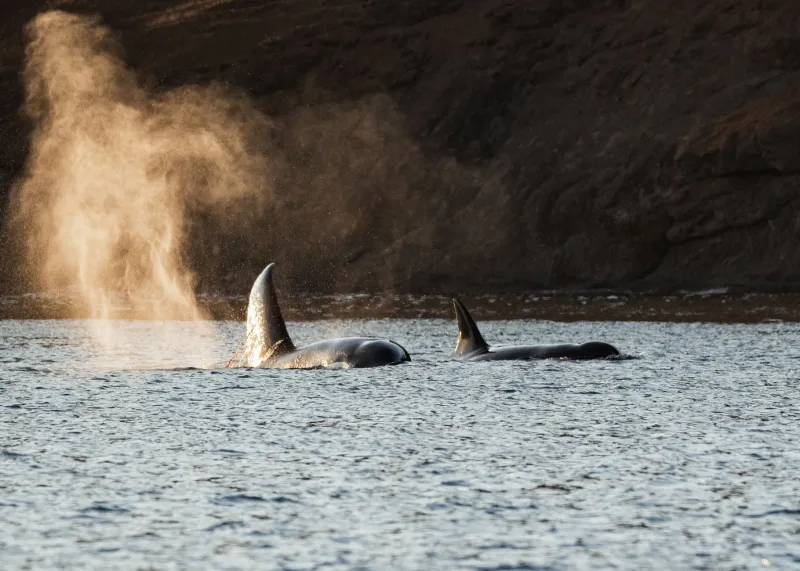
Southern Resident killer whales are organized into three pods — J, K, and L — each of which maintains a distinct matrilineal social structure. Calves remain with their mothers for life. Adult males, despite their impressive size and visibility, are deeply dependent on their mothers for social orientation and, in lean years, for direct food sharing. The entire architecture of Southern Resident society is built around female lineages.
This means that when a breeding female dies — particularly one who has already raised multiple offspring — the damage radiates outward in ways that simple population counts cannot fully capture. The loss is not merely numerical. It is structural. A pod that loses its most experienced matriarch loses not just a reproductive unit, but an organizing intelligence around which younger whales calibrate their behavior.
Conversely, pods with stable multi-generational female leadership demonstrate what researchers describe as a compounding social advantage. Grandmothers support their daughters' reproductive success by assisting in calf care and reducing the energetic burden on younger females. This frees breeding-age females to invest more fully in gestation and lactation — both metabolically expensive processes that are easily disrupted by nutritional stress or chronic disturbance.
Where Policy Has Fallen Short
Despite this evidence, current federal recovery plans for Southern Resident killer whales do not explicitly prioritize the protection of elder post-reproductive females as a distinct conservation category. The NOAA Southern Residents Recovery Plan, while comprehensive in many respects, treats population growth primarily through the lens of calf production — a metric that, while important, fails to account for the disproportionate social and ecological value of older females.
This is a policy blind spot with measurable consequences. When vessel disturbance disrupts foraging, it is the energetically marginal individuals — pregnant females, nursing mothers, and elderly whales operating on reduced caloric reserves — who bear the greatest physiological cost. When toxic contaminant burdens accumulate across a lifetime of exposure, it is the oldest females who carry the highest loads, compromising their immune function and reproductive viability. When prey collapses force pods into extended foraging excursions, it is the youngest and oldest animals who are most vulnerable to nutritional collapse.
A recovery framework that does not explicitly account for the outsized ecological value of elder females is, in effect, optimizing for the wrong variable.
Toward a Matriarch-Centered Conservation Model
What would it look like to genuinely center female leadership in Southern Resident recovery policy? Several concrete interventions follow logically from the science.
First, vessel exclusion zones and acoustic buffer protocols should be calibrated not just by proximity to any whale, but by proximity to identified matriarchs and breeding females. The behavioral disruption cost of a vessel encounter is not uniform across individuals — and policy should reflect that asymmetry.
Second, emergency feeding programs, when and if they are deployed during periods of acute prey scarcity, should prioritize the nutritional needs of elder females and pregnant or lactating mothers. Keeping these individuals alive and reproductively viable has a multiplier effect on overall pod health that far exceeds what the same resources would achieve if distributed without regard to social role.
Third, toxics reduction efforts — including accelerated cleanup of legacy PCB contamination in Puget Sound and the broader Salish Sea — must be treated as a direct investment in matriarch longevity. These animals bioaccumulate pollutants across decades of life. Every year of delay in reducing contaminant loads is a year in which the whales most critical to pod cohesion are being systematically undermined.
Finally, federal and state recovery plans should formally recognize the concept of "social capital" in Southern Resident populations — acknowledging that the loss of a matriarch represents a qualitatively different kind of harm than the loss of a younger, less socially central individual. This recognition should be reflected in how mortality events are assessed, how mitigation measures are prioritized, and how recovery progress is measured.
The Irreducible Value of Lived Experience
There is something deeply clarifying about the grandmother effect as a scientific concept: it quantifies, in rigorous biological terms, what many Indigenous communities of the Pacific Northwest have understood for generations. The elders carry knowledge that cannot be improvised or downloaded. It is accumulated through time, encoded in behavior, and transmitted through relationship.
For the Southern Residents, that knowledge lives in the bodies of a shrinking number of aging females. J35, known as Tahlequah, who carried her deceased calf for 17 days in a display of grief that captured international attention, is now herself a grandmother. The elder females of K and L pods carry histories of the Salish Sea that stretch back half a century.
Protecting these animals is not sentiment. It is strategy — arguably the most evidence-based strategy available to us. Any recovery plan that does not treat the survival of elder breeding females as its first and most urgent priority is not, in any meaningful sense, a plan for recovery at all.