Splitting Apart to Survive: The Hidden Cost of Southern Resident Pod Fragmentation
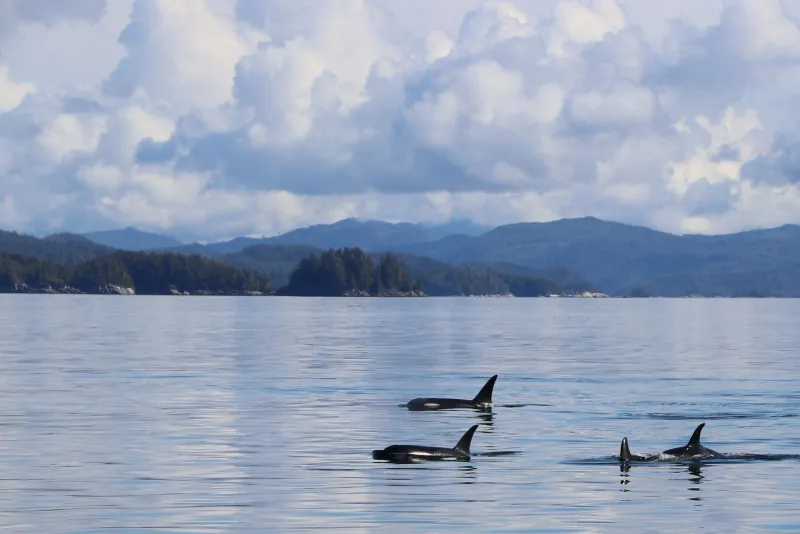
For generations, the Southern Resident killer whales of the Salish Sea have defined themselves not merely as a species, but as a society. Their identity is bound up in family — in the tight, matrilineal pods that travel together, hunt together, and pass knowledge from one generation to the next across decades. To observe J, K, or L pod moving in formation through the inland waters of Washington State is to witness something that feels genuinely ancient: a social architecture refined over thousands of years.
But that architecture is showing cracks.
Over the past two decades, researchers tracking the movement patterns of all three pods have documented an unmistakable trend: Southern Residents are spending increasing stretches of time in smaller, fragmented subgroups — sometimes separated by hundreds of miles, sometimes for weeks at a time. What was once a relatively cohesive community of roughly 75 to 80 whales now functions, more often than not, as a loose constellation of splinter groups navigating an ocean that no longer offers the salmon abundance these animals require.
The question that divides scientists and conservationists is deceptively simple: Is this fragmentation a sign of adaptation, or a symptom of collapse?
A Society Built on Proximity
To understand why pod separation matters, it is necessary to first understand what Southern Resident social structure actually provides. Unlike transient killer whales, which roam widely and hunt marine mammals in small, fluid groups, Southern Residents are highly philopatric — meaning they maintain extraordinarily strong fidelity to both their geographic range and their family units. Offspring, regardless of sex, remain with their mothers for life. This is not merely a behavioral curiosity; it is the foundation upon which Southern Resident culture rests.
Matriarchs — the eldest females in each pod — serve as living repositories of ecological knowledge. They remember where salmon were abundant in years past, how to navigate the Salish Sea's complex tidal systems, and how to coordinate group hunting strategies for Chinook, the large, fatty salmon that constitute the overwhelming majority of the Southern Resident diet. When pods travel together, this knowledge circulates. Younger whales learn by proximity, by imitation, and by participation in collective foraging events.
Separation disrupts that transmission. A juvenile whale traveling in a fragmented subgroup without access to an experienced matriarch is, in a meaningful sense, navigating without a map.
Scarcity as a Driver of Dispersal
The timing of increased pod fragmentation is not coincidental. It tracks closely with the decline of Chinook salmon runs throughout the Pacific Northwest — a collapse driven by dam-blocked spawning habitat, degraded river ecosystems, and a century of industrial overfishing. As the prey base has contracted, Southern Residents appear to have responded by spreading out, covering more geographic territory in search of fish that are no longer reliably concentrated in traditional foraging areas.
From a narrow ecological standpoint, this dispersal strategy carries a certain logic. A single large group competing for scarce salmon in one location may fare worse than several smaller groups searching independently across a broader range. Some researchers have suggested that the flexibility to split and reconvene — a behavior documented in other killer whale populations globally — may represent a genuine adaptive response rather than social dysfunction.
But the Southern Residents' situation introduces complications that make direct comparisons to other populations problematic. Their prey specialization is extreme. Their geographic range, while expansive on paper, is hemmed in by vessel traffic, noise pollution, and contaminant loads that constrain where and how effectively they can hunt. And critically, their total population — currently hovering around 73 individuals — is so small that the loss of experienced foragers or cultural knowledge-holders carries consequences that larger, healthier populations could absorb without lasting damage.
When Separation Becomes Erosion
Perhaps the most troubling dimension of increased pod fragmentation is its potential effect on cultural cohesion. Southern Residents possess one of the most complex vocal repertoires documented in any non-human animal. Each pod maintains a distinct set of calls — a dialect, in the most meaningful sense of that word — that serves as a marker of identity and a medium for social coordination. Frequent, prolonged separation means less opportunity for calves and juveniles to fully internalize those dialects, less reinforcement of the shared vocalizations that bind pod members to one another.
The concern is not merely sentimental. Researchers have long understood that Southern Resident dialects are functionally important — they facilitate coordinated hunting, maintain social bonds across distances, and likely play a role in the transmission of behavioral traditions. A population in which dialect fidelity weakens is a population whose internal communications infrastructure is degrading.
There is also the matter of reproductive dynamics. Southern Resident males, who depend on their mothers throughout their lives, are less likely to encounter potential mates when pods are fragmented and geographically dispersed. In a population already burdened by severe inbreeding concerns — a consequence of decades of small population size — reduced inter-pod contact during critical mating windows only compounds an already precarious genetic situation.
What Policy Must Confront
The fragmentation of Southern Resident pods is not an isolated behavioral phenomenon. It is a downstream consequence of policy failures — the failure to restore Chinook salmon runs at the scale these whales require, the failure to meaningfully reduce vessel noise and disturbance in critical foraging habitat, and the failure to treat the Southern Residents as what they genuinely are: a culturally complex, ecologically specialized population whose survival depends on conditions that human activity has systematically dismantled.
Addressing pod fragmentation, then, cannot be reduced to a behavioral management question. It demands a reckoning with salmon recovery. It demands serious engagement with the four lower Snake River dams, whose removal would reopen hundreds of miles of critical spawning habitat and restore one of the Southern Residents' most historically productive salmon sources. It demands vessel traffic regulations with real enforcement teeth, particularly during the summer foraging season when whales and boats converge in the San Juan Islands and Puget Sound.
It demands, in short, the kind of systemic intervention that government agencies and political leaders have consistently deferred in favor of incremental half-measures.
The Weight of What Is Being Lost
There is a tendency in conservation discourse to frame population decline in terms of numbers — individuals lost, calves not born, survival rates trending downward. These metrics matter. But the fragmentation of Southern Resident pods represents a different kind of loss, one that numbers alone cannot fully capture.
What is eroding is a social world. A web of relationships, knowledge, and cultural practice that has been centuries in the making. Every prolonged separation between pod members is a gap in the transmission chain. Every matriarch lost before her knowledge can be fully passed on is an irretrievable subtraction from the collective memory of a people — because that is precisely what the Southern Residents are: a people, in every sense that word implies depth and continuity and shared meaning.
The fractures forming within J, K, and L pods are not merely behavioral data points. They are a measure of how much has already been taken from these whales — and a warning about how much more stands to be lost if the policy failures that have brought them to this threshold are allowed to continue.